
EPSO AD5 vs AST vs CAST: Which Competition Is Right for You?
May 20, 2026
If you’ve been looking into career opportunities within the European Union, there’s a good chance you’ve already seen the term EPSO. For many graduates and professionals, EPSO competitions are one of the main ways to start a career within EU institutions and agencies.
For first-time candidates, the process can feel quite different from a regular job application. Instead of focusing mostly on interviews and CVs, EPSO competitions include several assessment stages that test reasoning, analytical thinking, communication, and the ability to work under pressure.
Because of this, many candidates realise that preparing for EPSO requires a different mindset compared to university exams or standard recruitment processes.
So, what exactly is EPSO, how does the process work, and what should candidates know before applying?
What is EPSO?
EPSO stands for the European Personnel Selection Office. It is responsible for organising recruitment competitions for a wide range of EU institutions and agencies, including:
- the European Commission
- the European Parliament
- the Council of the European Union
- various EU agencies and bodies
The EPSO system is designed to identify candidates who can work effectively in demanding, international, and multilingual environments.
Unlike many traditional recruitment systems, EPSO competitions focus heavily on assessments that measure:
- analytical thinking
- problem-solving
- decision-making
- written communication
- accuracy under pressure
For this reason, strong theoretical knowledge alone is often not enough. Candidates also need to understand how EPSO assessments are structured and how different skills are evaluated.
How does the EPSO process begin?
Every EPSO competition officially starts with a document called the Notice of Competition.
This document contains the key details related to a specific competition, including:
- eligibility requirements
- application deadlines
- required languages
- test structure
- scoring methods
- reserve list information
- responsibilities connected to the role
Since requirements may vary depending on the competition profile, candidates should always carefully review the Notice of Competition before applying.
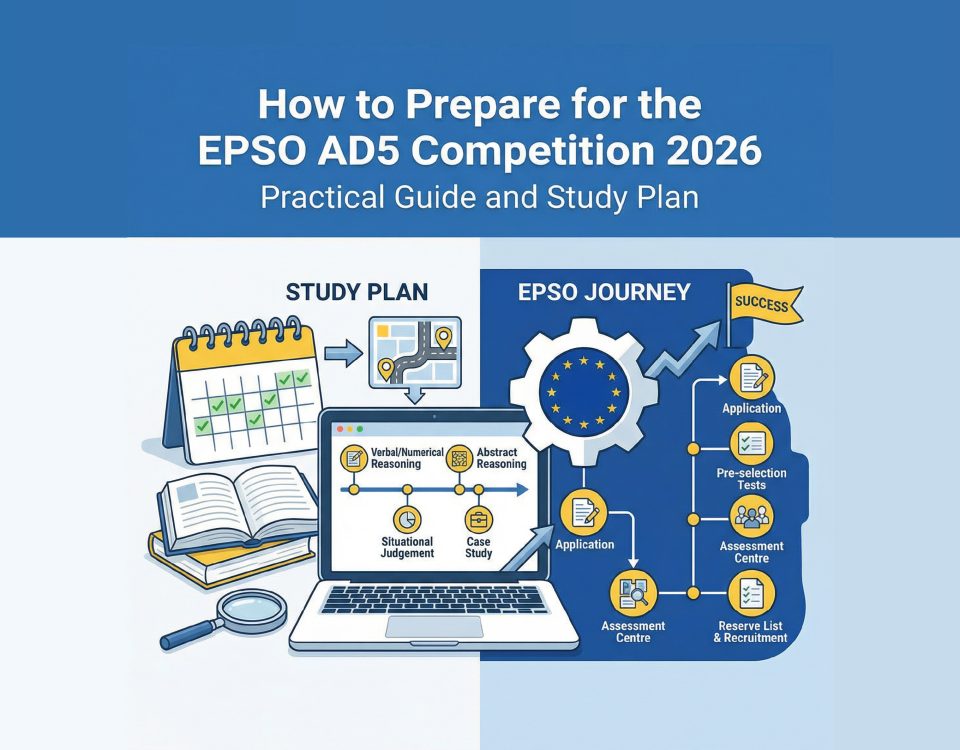
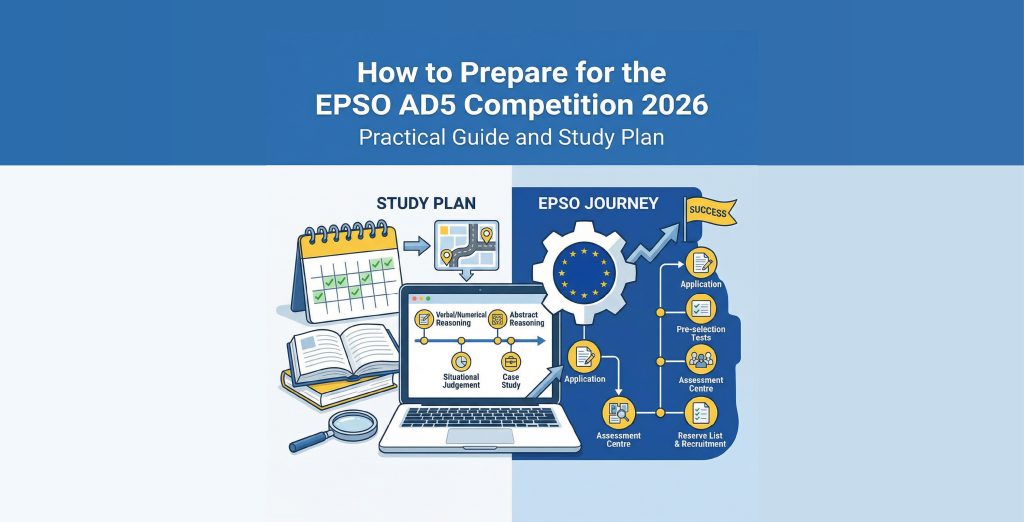
In most cases, the process includes:
2️⃣ Applying before the official deadline
3️⃣ Completing the required assessments
4️⃣ Uploading supporting documents if requested
5️⃣ Undergoing eligibility checks and final evaluation
Once an application is validated, changes are usually no longer possible, which is why candidates are encouraged to review all information carefully before final submission.
Who can apply for EPSO competitions?
Eligibility requirements depend on the competition profile, but most EPSO procedures generally require candidates to:
- hold citizenship of an EU Member State
- know at least two EU languages
- meet diploma requirements specified in the competition notice
- fulfil any applicable national obligations
Some profiles, such as translators or lawyer-linguists, may require additional language qualifications or specialised educational backgrounds.
Because requirements can differ by profile, candidates should always confirm the exact conditions before applying.
What types of EPSO competitions exist?
EPSO organises several categories of competitions depending on the position and career path:
| Competition | Full Meaning | Main Focus | Typical Areas |
|---|---|---|---|
| AD | Administrator | Policy and analytical work | Law, economics, administration, project management |
| AST | Assistant | Operational and support responsibilities | HR, finance, communication, coordination |
| CAST | Contract Agents Selection Tool | Flexible contract opportunities | Administration, IT, project support, communication |
Looking for a more detailed explanation of AD5, AST, and CAST competitions?
Read the full EPSO competition guide here
What do EPSO exams usually include?
Most EPSO competitions begin with computer-based tests (CBT) completed online under timed conditions.
Depending on the competition profile, candidates may encounter:
| Assessment | Purpose |
|---|---|
| Verbal Reasoning | Evaluates the ability to analyse and interpret written information under time pressure. |
| Numerical Reasoning | Measures accuracy when working with calculations, charts, percentages, and numerical data. |
| Abstract Reasoning | Assesses logical thinking and the ability to recognise patterns and relationships. |
| EU Knowledge | Tests understanding of EU institutions, policies, and decision-making structures. |
| Digital Skills | Evaluates digital literacy and familiarity with modern digital competencies. |
| EUFTE | Assesses written communication, structure, clarity, and argument development. |
Why do many candidates find EPSO difficult?
One of the most underestimated aspects of EPSO competitions is the pressure created by timing.
Even candidates who understand the material well may struggle with:
- maintaining concentration for extended periods
- balancing speed and accuracy
- recovering after difficult questions
- staying calm under pressure
Many people prepare by reading explanations or solving untimed exercises, but the real exam environment often feels significantly more demanding once the timer starts.
Because of this, successful preparation is not only about understanding concepts. It is also about becoming familiar with the pace, structure, and pressure of the assessment environment.
What is CBT and why does it matter?
CBT stands for Computer-Based Testing – the format used for many EPSO exams.
For many candidates, the difficult part is not only solving the questions, but also keeping focus, managing time, and staying calm under pressure.
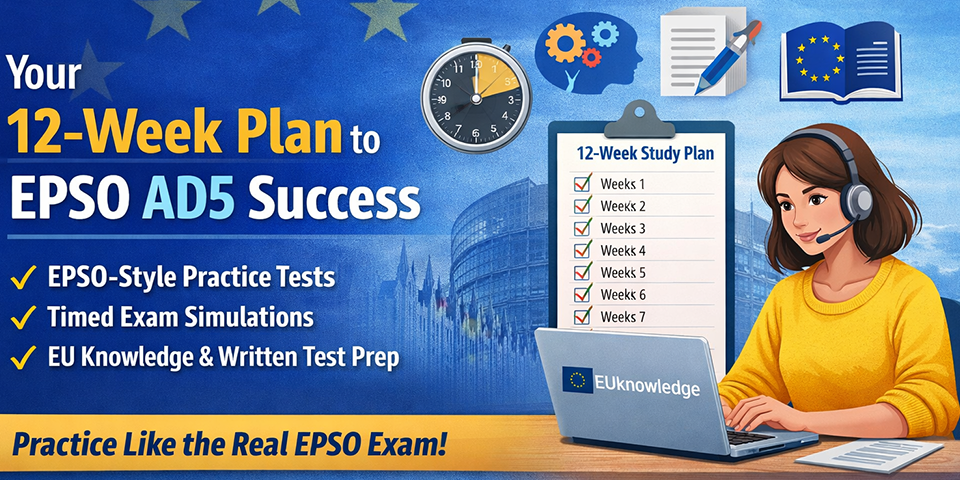
How to prepare more effectively for EPSO
Many successful candidates prepare gradually and consistently rather than trying to study everything within a short period of time.
Preparation usually becomes more effective when candidates focus on:
- practising realistic EPSO-style questions
- completing timed simulations
- identifying weaker areas
- improving time management
- building consistency
- becoming familiar with the CBT environment
In many cases, shorter but regular study sessions are more productive than long study days that lead to burnout and fatigue.
Common mistakes candidates make
Focusing only on theory
Understanding concepts is important, but practical exam performance matters equally. Many candidates underestimate how different EPSO exams feel under strict timing conditions.
Ignoring time pressure
Some candidates perform well during untimed practice sessions but struggle once official timing conditions are introduced during the real exams.
Practising inconsistently
Long gaps between study sessions can reduce concentration, preparation rhythm, and overall confidence over time.
Neglecting certain test areas
Some candidates focus heavily on stronger sections while overlooking areas such as numerical reasoning or digital skills.
How EU Knowledge supports EPSO preparation
Preparing for EPSO competitions can feel challenging, especially for candidates experiencing this type of assessment for the first time.
That is why EU Knowledge provides a preparation system specifically designed around the EPSO selection process and CBT environment. Instead of focusing only on theory, the platform helps candidates become more familiar with the structure, timing, and pace of real EPSO assessments.
The platform includes:
- realistic timed simulations
- verbal, numerical, and abstract reasoning practice
- AD5-focused preparation packs
- progress tracking and performance analysis
- flexible online learning adapted to different schedules
By practising within an EPSO-oriented system, candidates can improve weaker areas, build consistency, and prepare more effectively for the real exam environment.