
5 Myths About EPSO Exams That Could Hurt Your Chances
September 23, 2025
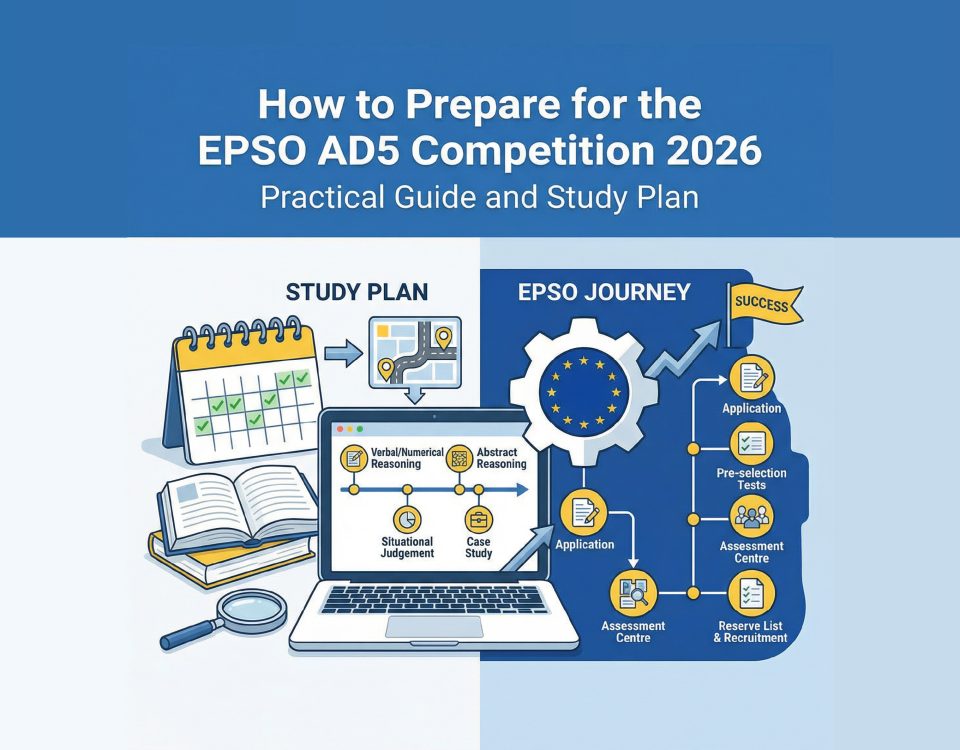
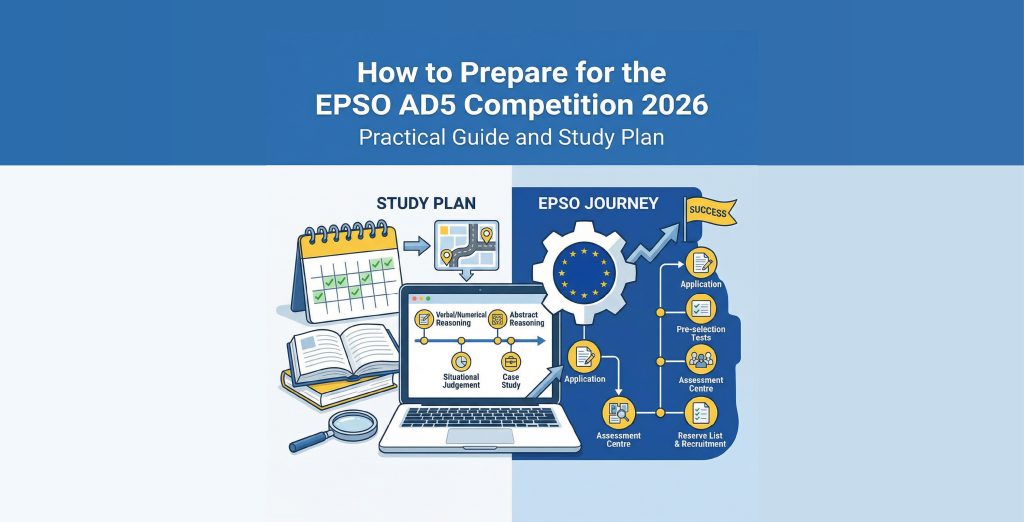
How to Prepare for the EPSO AD5 Competition 2026: Practical Guide and Study Plan
March 15, 2026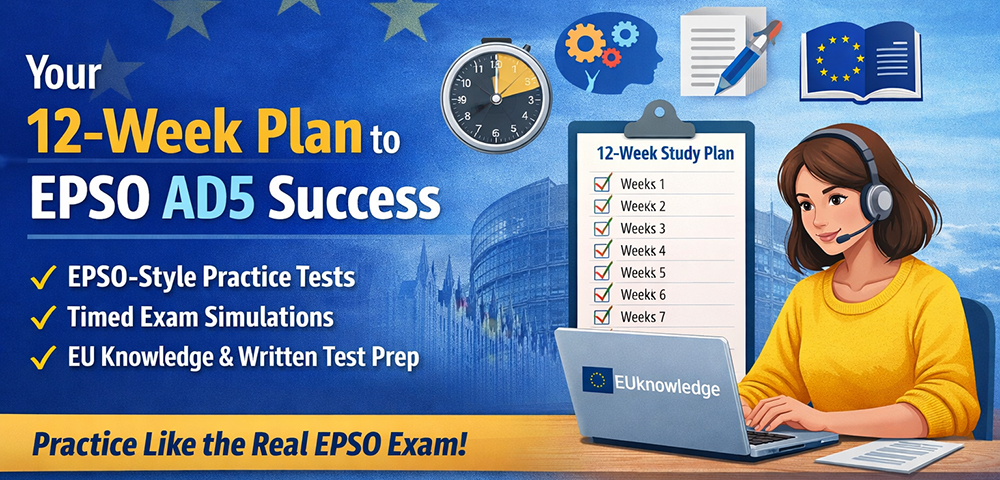
Preparing for the EPSO AD5 Administrators competition is easier when you focus on essentials: what the competition requires, how the tests work and how to build a realistic study plan. The 2026 AD5 “Graduates” competition offers 1 490 places on the reserve list, making it one of the biggest entry points into a permanent EU career. You can apply with any Bachelor’s degree, regardless of work experience.
This guide summarises the official AD5 selection process and provides a long‑term preparation plan with practical tips and tricks. You’ll find key facts, resources and a 12‑week study plan to maximise your chances.
Key facts (quick check)
- Application deadline: 10 March 2026
- Eligibility: EU citizenship and at least a Bachelor’s degree
- Tests: Reasoning (verbal, numerical, abstract), EU knowledge, digital skills and EUFTE written test
- Languages: Tests are taken in two languages (Language 1 and Language 2)
Getting started: rules, deadlines and the Notice of Competition
Good preparation begins with the right mindset and a clear understanding of the rules. The Notice of Competition (NoC) is your legally binding manual: read it to understand eligibility requirements, such as EU citizenship and having a Bachelor’s degree of at least three years by 30 September 2026. Start early—ideally 10–12 weeks in advance—and manage exam‑day stress with a structured plan. Don’t prepare in isolation: join AD5 candidate communities (forums or social media groups) to share insights and stay informed.
The four blocks of AD5 preparation
Block 1: Reasoning Skills – the foundation
Reasoning tests assess your cognitive abilities rather than knowledge. Accuracy under time pressure is the greatest challenge, so you must learn to find the right answer quickly. The verbal reasoning test contains 20 questions in 35 minutes with a pass mark of 10/20. Numerical and abstract reasoning together require a combined pass mark of 10/20.
Preparation tips:
- Start with the EPSO official sample tests to familiarise yourself with the interface. Watch free methodology webinars if you’re new to reasoning skills.
- Invest in reasoning test bundles or attend live workshops for exam‑like practice. Personal coaching can provide tailored feedback.
- Boost your speed with speed‑reading and mental maths apps.
Block 2: The Knowledge Block
The EU knowledge and digital skills tests account for 50 % of your final score. The EU knowledge test contains 30 multiple‑choice questions in 40 minutes and covers institutions, law and major policies like the digital economy and climate change. The digital skills test includes 40 questions in 30 minutes and assesses digital literacy based on the DigComp framework.
Preparation tips:
- Review free policy briefings and use the Europass digital skills tool to establish your baseline.
- Stay up to date by reading Politico Playbook and Eurobarometer surveys; follow EU policy news to understand current priorities.
Block 3: The Communication Block (EUFTE written test)
The EU Free‑Text Essay (EUFTE) assesses your written communication skills rather than EU facts. Two weeks before the exam, EPSO provides a background document. On test day, you have 40 minutes to complete a written assignment in your second language. Assessors evaluate clarity, structure and audience awareness.
Preparation tips:
- Read guidance articles (e.g. “8 Steps to Ace the EPSO Written Test”) and listen to relevant podcasts.
- Join webinars that teach EUFTE methodology and allow practice with feedback.
- Practise writing essays: outline your argument, plan your structure and keep language clear and concise.
Block 4: Beyond Exam Prep – wellbeing and strategy
Success isn’t just about books; it’s about sustaining performance over several months. Connect with national EPSO ambassador networks for local information sessions. Use productivity tools like Notion or Pomodoro timers to stay focused. After the exam, attend reserve list strategy webinars to learn how to lobby for a job and tailor your CV.
Step‑by‑step preparation (12‑week plan)
If you have several months to prepare, follow this structured plan to build accuracy, speed and confidence.
Step 1: Understand the rules
Read the Notice of Competition thoroughly. Note the application deadline, eligibility requirements and test structure. Update your EU Training profile to receive reminders about the 10 March 2026 deadline.
Step 2: Build your study schedule
Plan a 12‑week study calendar. Commit to 3–4 hours per week, split into 30–45 minute sessions. Use the phases below to structure your time.
Step 3: Focus on reasoning accuracy (Weeks 1–4)
- 3 sessions/week: untimed then lightly timed practice on verbal, numerical and abstract reasoning.
- 1 session/week: mixed set to build endurance.
- After each session: review mistakes and note patterns.
Step 4: Increase speed and depth (Weeks 5–8)
- 3 sessions/week: timed reasoning sets, gradually reducing time per question.
- 1 session/week: longer mixed session to build stamina.
- 1 short session/week: targeted drills for your weakest topics (e.g. EU procedures, percentages, pattern recognition).
- Supplement your knowledge: read policy briefings and practise digital skills scenarios.
Step 5: Simulate the full exam (Weeks 9–12)
- 2 sessions/week: full mock exams under strict timing and exam conditions.
- 2 sessions/week: targeted drills to fix remaining weaknesses.
- Practise EUFTE essays: use the background document to plan and write within 40 minutes.
Step 6: Maintain wellbeing and prepare for success
- Join a community: connect with fellow candidates on forums or social media to share tips and stay motivated.
- Use productivity tools and stress‑management techniques to keep focused.
- After the exam, explore reserve list strategy resources to enhance your recruitment prospects.
What you get with EUknowledge
- Timed practice environment that replicates exam conditions to build confidence.
- Focused question banks covering verbal, numerical and abstract reasoning.
- Clear progression with packs of different sizes (200, 400 or 800 questions).
- Unlimited retakes so you can practise until each question type becomes automatic.
Choose your AD pack
Select a pack based on how much repetition you need over your preparation period.
- AD5 200: 200 verbal questions, 100 numerical questions, 100 abstract questions. Best for a short refresh or light preparation.
- AD5 400: 400 verbal questions, 200 numerical questions, 200 abstract questions. Best for 8–12 weeks of steady training.
- AD5 800: 800 verbal questions, 400 numerical questions, 400 abstract questions. Best for maximum repetition and full simulations.