
How to Prepare for the EPSO AD5 Administrators 2026: Step by Step Guide
February 22, 2026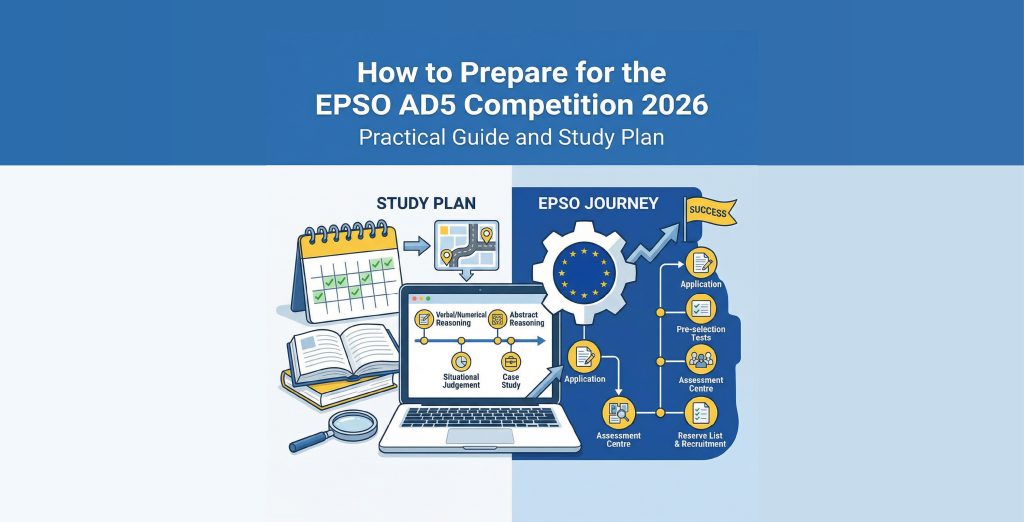
How to Prepare for the EPSO AD5 Competition 2026: Practical Guide and Study Plan
The European Personnel Selection Office (EPSO) has finally reopened the AD5 generalist competition, the main entry route into a permanent EU career. Applications opened on 5 February 2026 and close at 12:00 (Brussels time) on 10 March 2026. If you’re a graduate with EU citizenship and strong command of two EU languages, this competition offers a chance to join the EU institutions on a starting salary of around €6,000 a month. The process is competitive but predictable: the test structure, pass marks and weightings are set out in the Notice of Competition. By building a smart preparation plan and practising under exam conditions, you can move yourself into the pool of candidates who are genuinely competitive.
Competition Snapshot: Key dates, eligibility, tests and a 10-week plan — all in one place.
Competition Snapshot
- Applications: Opened 5 February 2026; deadline 10 March 2026 (12:00 Brussels). ID/passport must be uploaded by the same deadline; supporting documents by 7 October 2026.
- EPSO reference: EPSO/AD/427/26 (AD5 Graduate Administrators).
- Reserve list places: 1 490 candidates.
- Eligibility: EU citizenship plus a university degree of at least three years (awarded by 30 September 2026); no work experience required.
- Languages: choose a Language 1 (C1 level) and a different Language 2 (B2 level); reasoning tests in Language 1, all other tests in Language 2.
- Tests: Computer-based reasoning (verbal, numerical & abstract), EU Knowledge MCQ, Digital Skills MCQ and EU Free-Text Essay (EUFTE).
- Scoring: Verbal reasoning carries 35 % of the final score, EU knowledge 25 %, digital skills 25 % and EUFTE 15 %. Numerical and abstract reasoning are pass/fail only.
- Remote testing: All tests are taken online via EPSO’s TAO platform.
1. What the AD5 competition is (and who it’s for)
AD5 is the entry-level grade for administrators working in the EU institutions. This competition recruits generalist graduates to join policy units, legal services and operational teams across the European Commission, Parliament, Council and agencies. The job profile is broad: annexes in the Notice of Competition describe duties such as policy analysis and formulation, drafting legal acts, coordinating with member-state administrations, managing projects and resources, and representing the institution in meetings. Successful candidates join a multicultural environment with the opportunity to influence EU legislation and programmes.
Who can apply
1. Citizenship: you must be a national of an EU Member State.
2. Education: you need a university degree based on at least three years of studies (bachelor’s or equivalent), awarded by 30 September 2026.
3. Languages: you must select two official EU languages. Language 1 (C1 level) is used for the reasoning tests; Language 2 (B2 level) is used for the EU knowledge, digital skills and EUFTE tests.
4. Character and military obligations: you must meet the general requirements of good conduct and fulfil any national service obligations.
No professional experience is required. This competition is therefore ideal for recent graduates or early-career professionals who want to move directly into EU policy work. With 1 490 places on the reserve list and a high applicant pool (estimates suggest up to 50 000 applicants), preparation and strategy are crucial.
2. Selection process step-by-step
The competition follows a clear sequence of phases. The key dates below reflect official announcements and guidance from EPSO and Member-State support services. Note that exact testing windows may vary; EPSO allocates slots across several weeks to handle the volume of candidates.
| Phase | What happens | Provisional timing |
|---|---|---|
| Application | Create/complete your EPSO profile via the Single Candidate Portal and submit your form with a scanned ID/passport. Include your language choices and degree details. | 5 Feb – 10 Mar 2026 |
| Supporting documents upload | After application, upload evidence of qualifications and any supporting documents to your EPSO account. | Deadline: 7 Oct 2026 |
| Reasoning tests (verbal, numerical & abstract) | Remote, multiple-choice tests in Language 1. You must achieve at least 10/20 in verbal and a combined 10/20 in numerical+abstract to progress. | Late Mar – Jun 2026 (EPSO has indicated April/May/June windows) |
| EU knowledge test | 30 MCQs in Language 2 on EU institutions, procedures and policy areas; pass mark 15/30. | Taken after you pass reasoning tests; same booking window |
| Digital skills test | 40 MCQs in Language 2 assessing digital literacy across five DigComp areas (information and data literacy, communication & collaboration, digital content creation, safety and problem solving). Pass mark 20/40. | Immediately after EU knowledge test |
| EUFTE (free-text essay) | 40-minute written assignment in Language 2; not a language test but assesses structure, clarity and message. You receive background documents about two weeks before the exam; pass mark 5/10. | Only the top-ranked candidates (up to ~1.5× reserve list) have their essays marked; expected Aug–Sep 2026 |
| Eligibility check | For those with EUFTE scored, EPSO verifies eligibility against the rules (citizenship, degrees, languages). | Sep 2026 |
| Reserve list | EPSO compiles an alphabetical list of successful candidates (1 490 names) for recruitment. | Oct – Nov 2026 |
3. Tests explained
Understanding each test will help you allocate study time intelligently. Focus on the tests that carry the most weight in the final ranking: verbal reasoning, EU knowledge, digital skills and EUFTE.
3.1 Reasoning skills (verbal, numerical & abstract)
Reasoning tests assess your cognitive abilities rather than factual knowledge. They are in Language 1 and are computer-based multiple-choice questions (MCQs). You can sit them from home via EPSO’s TAO platform.
| Test | Questions & time | Pass mark | Role in ranking | How to prepare |
|---|---|---|---|---|
| Verbal reasoning | 20 MCQs in 35 min | 10/20 | Weighted 35 % in final score | Practise reading dense passages and extracting key information quickly. Use timed exercises to build speed, and review EU vocabulary. EUknowledge’s verbal reasoning simulations mirror the EPSO interface. |
| Numerical reasoning | 10 MCQs in 20 min | Combined pass score of 10/20 with abstract | Pass/fail only – does not influence ranking | Refresh basic maths (fractions, percentages, ratios). Use a calculator effectively and practise interpreting graphs and tables. Focus on accuracy: there is no bonus for high scores once you pass. |
| Abstract reasoning | 10 MCQs in 10 min | Combined pass score of 10/20 with numerical | Pass/fail only – does not influence ranking | Solve pattern-recognition puzzles and practise eliminating incorrect options quickly. Train with timed drills to build intuition. EUknowledge offers hundreds of abstract-reasoning items with full explanations. |
Tip: Because numerical and abstract reasoning are gatekeepers, aim to hit the pass mark comfortably but prioritise verbal reasoning, which carries the largest weighting.
3.2 EU Knowledge test
This 30-question MCQ assesses your understanding of EU history, institutions, decision-making procedures and policy priorities. It is taken in Language 2 and lasts 40 minutes. You must score at least 15/30. The results count for 25 % of your final score.
What it measures: familiarity with the “trunk and branches” of the EU – treaties, competencies, legislative procedures, and current policies (e.g., digital transformation, climate action, foreign policy). Questions may ask you to choose correct statements, identify institutional roles or interpret EU policy scenarios.
Preparation tips:
- Read the official sources EPSO will reference (the reference list is published on the EPSO website after the Notice).
- Study the EU Treaties, institutional structures, and legislative processes.
- Stay up to date with current EU priorities by following official briefings and reputable news (e.g., Politico Europe, Parliament’s Eurobarometer reports).
- Use EUknowledge’s EU-knowledge question bank to practise under timed conditions; each question comes with a detailed explanation.
3.3 Digital Skills test
EPSO has introduced a dedicated digital literacy test aligned with the DigComp 2.2 framework. It consists of 40 MCQs in Language 2, taken over 30 minutes, with a pass mark of 20/40. The test contributes 25 % of the final score.
What it measures: your ability to understand and use digital technologies across five areas: information & data literacy, communication & collaboration, digital content creation, safety, and problem solving. Questions may include selecting safe actions in a cybersecurity scenario, interpreting digital footprints, or choosing tools for collaborative work.
Preparation tips:
- Familiarise yourself with the DigComp framework and definitions of each area.
- Practise with EUknowledge’s digital-skills modules, which cover typical question formats and provide explanations of correct and incorrect answers.
- Improve your digital fluency: explore productivity tools, collaboration platforms and data-visualisation basics.
- Stay aware of EU digital policies (e.g., data protection, cybersecurity) to contextualise questions.
3.4 EUFTE (EU Free-Text Essay)
The EUFTE is a 40-minute essay in Language 2. It is not a language test but evaluates written communication – clarity, structure, audience awareness and coherence. You receive background documentation about two weeks before the test and must base your response on this material. The pass mark is 5/10, and the test accounts for 15 % of the final ranking.
Preparation tips:
- Practise summarising complex texts and formulating a clear, balanced argument within a strict time limit.
- Learn to structure your essay: introduction, body with 2–3 arguments, conclusion.
- Focus on clarity and accuracy rather than trying to impress with jargon.
- Use EUknowledge’s EUFTE simulations to practise writing responses based on official-style documents and get feedback on structure and style.
4. Recommended study plan (10-week schedule)
Starting preparation 10–12 weeks before the tests gives you enough time to cover all components without burning out. The following 10-week plan assumes you begin around mid-January for a spring test window. Adapt it to your schedule, but keep the focus on the high-weight tests.
| Week | Focus | Actions & resources |
|---|---|---|
| Week 1 | Orientation & rules | Read the Notice of Competition thoroughly and update your EPSO profile. Clarify eligibility, languages and deadlines. Watch EUknowledge’s free orientation webinar. |
| Week 2 | Verbal reasoning foundations | Practise reading comprehension exercises daily. Complete at least 60 EUknowledge verbal MCQs under 35-minute timing. Review explanations to identify common traps. |
| Week 3 | Numerical & abstract reasoning basics | Review core maths concepts; practise numerical and abstract tests using EUknowledge’s timed quizzes. Aim for 80 % accuracy in this “gatekeeper” phase. |
| Week 4 | EU knowledge overview | Map the EU institutions, treaties and legislative process. Use official summaries and EUknowledge’s EU Knowledge modules. Take a diagnostic test to assess your baseline. |
| Week 5 | Digital skills fundamentals | Study the DigComp areas. Complete sample digital-skills questions to identify weak areas. Explore topics like data privacy, collaborative tools and cyber hygiene. |
| Week 6 | Verbal & EU knowledge intensification | Alternate days between verbal reasoning and EU knowledge. Simulate two full verbal tests and one full EU-knowledge test at the end of the week. Analyse results using EUknowledge analytics. |
| Week 7 | Digital skills & numerical refresh | Continue digital-skills practice with timed sets. Revisit numerical & abstract reasoning to ensure pass-mark confidence. |
| Week 8 | EU knowledge deep dive | Study policy areas such as climate, digital transition and foreign policy. Use EU knowledge Q&A sessions or study groups. Take another full EU-knowledge test. |
| Week 9 | EUFTE preparation | Practise writing 40-minute essays based on EU-themed documents. Get feedback on structure and clarity. Review grammar and style guidelines. |
| Week 10 | Full mock exams & final review | Take complete simulations of the reasoning, EU knowledge and digital-skills tests in one sitting. Reflect on time management and stress-management strategies. Schedule a final EUFTE simulation. |
5. Practice strategy
To perform well on the EPSO AD5 tests, you need more than theoretical knowledge. You must be able to recall information and solve problems quickly and accurately under time pressure. Here’s how to maximise your practice:
1. Simulate the official environment: EPSO uses the TAO platform for remote testing. Practise with EUknowledge’s simulations that replicate the TAO interface. Learn how to open the calculator and scratchpad, flag questions for review and navigate between items quickly.
2. Train with timed sessions: Always set the official time for each test. This conditions your brain to work at the required speed and helps you develop pacing strategies (e.g., spending ~90 seconds per verbal question and moving on when stuck).
3. Review mistakes methodically: After each practice session, analyse why you missed questions. Did you misread the passage? Did you rush calculations? EUknowledge’s detailed explanations make it easier to spot patterns in your errors.
4. Balance breadth and depth: For EU knowledge and digital skills, cover the breadth of topics first, then deepen your understanding of weaker areas. Create flashcards or summary notes to revisit frequently.
5. Build endurance: As the competition involves multiple tests in one day, practise two or more tests back-to-back to build mental stamina.
6. Common mistakes and how to avoid them
- Ignoring the Notice of Competition. Many candidates skip this document and rely on hearsay. The Notice is legally binding and contains the definitive rules. Read it carefully and refer back often.
- Underestimating the ‘gatekeeper’ tests. Numerical and abstract reasoning are pass/fail only, but if you fail one, you are out of the competition. Ensure you can comfortably reach the combined 10/20 mark.
- Leaving digital skills until last. The digital-skills test is new, and some candidates neglect it. It counts for a quarter of your final score. Start practising early to avoid surprises.
- Mismanaging time. EPSO tests are intentionally time-pressured. Don’t obsess over one question; mark it for review and move on. Practise pacing yourself.
- Choosing unsuitable languages. Remember that Language 1 and Language 2 must be different. Choose your strongest language as Language 1 to maximise verbal reasoning performance, and ensure you can write fluently in Language 2 for EUFTE.
- Not checking technical requirements. Remote tests require stable internet, a compatible device and sometimes software installation. EPSO will send technical instructions. Run the checks early and avoid last-minute technical glitches.
7. Frequently asked questions
1. What degree do I need to apply? Any university degree of at least three years qualifies, regardless of field, as long as the diploma is awarded by 30 September 2026. No professional experience is required.
2. How should I choose my languages? Select your strongest language as Language 1 because it determines your reasoning tests. Language 2 must be different (minimum B2 level) and will be used for the EU knowledge, digital skills and EUFTE tests.
3. When will the tests take place? EPSO indicates that assessment tests will be scheduled across April to June 2026. Exact slots will be allocated via your EPSO account once booking opens. The EUFTE is likely later in the summer for the top-scoring candidates.
4. What is the pass mark for each test? Verbal reasoning: 10/20. Numerical + abstract reasoning: combined 10/20. EU knowledge: 15/30. Digital skills: 20/40. EUFTE: 5/10.
5. How is the final score calculated? EPSO uses a layered system. Only candidates who pass each test proceed. For the ranking, verbal reasoning contributes 35 %, EU knowledge 25 %, digital skills 25 % and EUFTE 15 %. Numerical and abstract reasoning scores do not affect your ranking.
6. Can I use a calculator during the numerical test? Yes. A basic on-screen calculator is provided within the testing interface. Practise using it during your preparation to avoid fumbling on test day.
7. Do I need to upload all supporting documents with my application? No. You must upload a scanned ID or passport by 10 March 2026. All other supporting documents (e.g., degree certificates) must be uploaded by 7 October 2026.
8. Is the EUFTE a language test? No. The EUFTE assesses written communication skills and the ability to organise and present information. Grammar and clarity matter, but it is not a language exam.
9. How many candidates will make the reserve list? EPSO plans to include 1 490 successful candidates on the AD5 reserve list. The final list is alphabetical and does not show ranking positions.
10. How competitive is the AD5 competition? Estimates suggest tens of thousands of applications. However, many applicants drop out or do not prepare adequately. Focused preparation, especially on the high-weight tests, dramatically increases your chances.
11. What happens after I’m on the reserve list? Being on the reserve list means you are eligible for job offers from EU institutions. It is not a job guarantee. You must actively apply to positions and may be invited for interviews by recruiting departments.
12. Where can I practise? EUknowledge provides more than 4 000 EPSO-style practice questions, realistic timed simulations, detailed explanations and performance analytics. You can try a free demo and explore our dedicated AD5 packages below.
8. Next steps – start practising with EUknowledge
Preparation is not a sprint; it’s a structured journey. With EUknowledge you can:
- Access realistic EPSO-style simulations that mirror the official test environment.
- Practise with 4 000+ questions across reasoning, EU knowledge, digital skills and EUFTE, each with step-by-step explanations.
- Track your performance with analytics dashboards to identify strengths and weaknesses.
- Enjoy affordable packages versus competitors, with flexible monthly subscriptions and a satisfaction guarantee.
Ready to start?
Try a free demo or browse our AD5 preparation packs. Smart, structured practice today sets you apart in the competition tomorrow.